TOUR

Mt Meru Trek

Duration

3 DAYS

Best Tanzania Safari offers Mt Meru Treks. The second highest mountain in Tanzania, this is a wonderful trek in its own right, but is also a great acclimatization trek before attempting Mt Kilimanjaro. There is only one route on Mt Meru and the trek is typically done in 4 days, although a 3 day itinerary is also possible. Overnights are in dormitory style huts with solar lighting, similar to Marangu Route on Mt Kilimanjaro. All treks are accompanied by an armed park ranger since at the lower altitudes there are a fair number of animals. Note: Depending on the availability of rangers, Arusha National Park has the authority to have groups from different tour companies share one park ranger. Each group will still have its own climb staff servicing their respective clients. But we cannot guarantee that your group will not be along side a different group since the decision to share a park ranger belongs to Arusha National Park Authorities exclusively. The packing list, suggested tips, mountain diet, safety, etc. for Mt Meru is the same as Mt Kilimanjaro.
Click to zoom

01 Day by Day

Arrival Day – Kilimanjaro Airport to Moshi

Distance

50 km (driving)

Elevation

1,000m - 1,200m

Trekking Time

1 hour (driving)

Zone Type

Town

Your Kilimanjaro adventure begins the moment you land. A Best Tanzania Safari driver will be waiting just outside the arrivals area, holding a sign with your name — no stress, no searching. Even if your flight is delayed or immigration takes longer than expected, they’ll be there. Once settled into your hotel in Moshi, you’ll meet your guide for an equipment check and a pre-climb briefing. This is your chance to ask every question on your mind, go over the route, and make sure everything is dialled in before the mountain begins. Gear rentals are available locally and are of excellent quality if you need anything. Tonight, rest well. Tomorrow, the adventure starts.
Day 1 – Momela Gate to Miriakamba Hut

Distance

~12 km

Elevation

1,500m - 2,514m

Trekking Time

5-6 hours

Zone Type

Montane Forest and Grassland

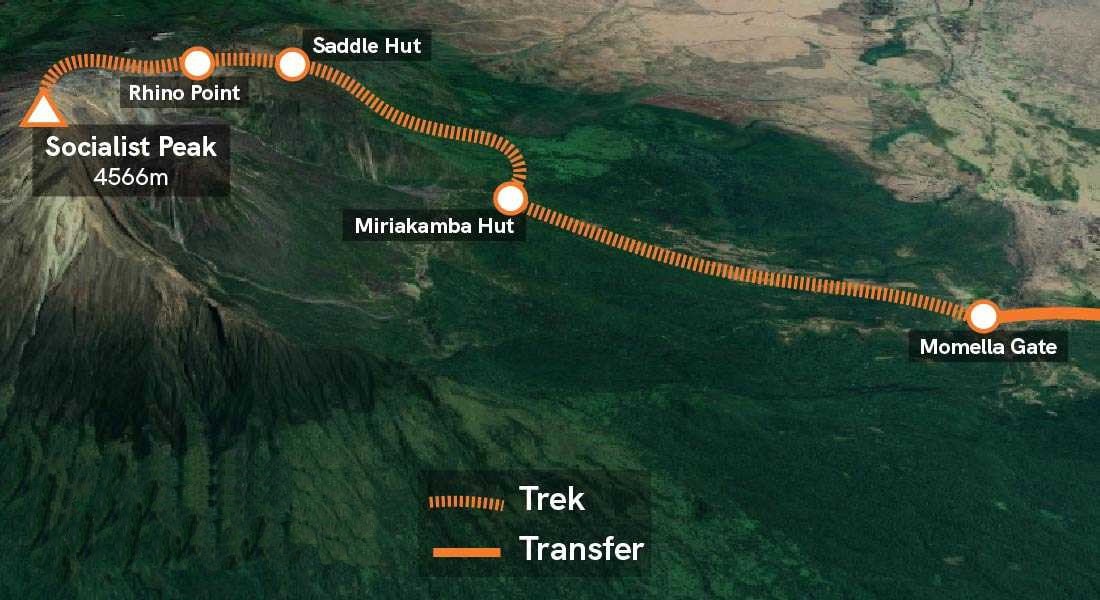
The Mt Meru adventure begins with a one-hour drive from Moshi to Momela Gate inside Arusha National Park, where you’ll meet your armed park ranger — a permanent and necessary companion on the lower slopes, where buffalo, warthog, and other wildlife roam freely. The trail heads out through open grassland before entering dense forest thick with birdsong and movement. Black and white colobus monkeys are a common sight in the canopy overhead. It’s a rich, wildlife-filled introduction to a mountain that consistently surprises those who climb it. Approximately 5-6 hours of walking. Dinner and overnight at Miriakamba Hut at 2,514m.
Day 2 – Miriakamba Hut to Saddle Hut

Distance

~8 km

Elevation

2,514m - 3,570m

Trekking Time

4-5 hours

Zone Type

Montane Forest and Moorland

Short in distance but sustained in effort — today is a steep, unrelenting climb all the way. The trail moves through open montane forest before pushing up through Elephant Ridge and into the giant heather and moorland zone surrounding Saddle Hut. You’ll arrive at Saddle Hut at around 2pm, leaving time for an acclimatization hike up to Little Meru (3,820m) before returning for dinner. The views from this ridge — across to Kilimanjaro on one side and down into Arusha National Park on the other — are genuinely breathtaking. Dinner and overnight at Saddle Hut at 3,570m.
Day 3 – Saddle Hut to Socialist Peak to Momela Gate

Distance

~26 km

Elevation

3,570m - 4,566m - 1,500m

Trekking Time

12-14 hours

Zone Type

Alpine and Desert

The summit push and descent — all in one day. You wake at 1am and begin the climb in darkness toward Socialist Peak at 4,566m, traversing the dramatic narrow ridge as dawn breaks over East Africa. Kilimanjaro’s snow-capped dome rises above the clouds in the distance — one of the great sunrise views on the continent. After the summit, you descend all the way back through Saddle Hut and Miriakamba Hut to Momela Gate in a single long day. Your vehicle returns you to Moshi or Arusha. Mt Meru: done.
Departure Day – Moshi to Kilimanjaro Airport

Distance

50 km (driving)

Elevation

1,200m - 1,000m

Trekking Time

1 hour (driving)

Zone Type

Town

Your Best Tanzania Safari driver will be ready at your hotel to transfer you to Kilimanjaro International Airport in plenty of time for your flight home — or your next adventure. Zanzibar? A safari in the Serengeti? The rest of Tanzania is waiting.

02 Know Before You Go

Several routes are available on Kilimanjaro, each offering a different experience. We generally recommend choosing the longest itinerary your time and budget allow, as slower ascents improve acclimatization and summit success rates. The Marangu Route is unique for its dormitory-style huts with solar lighting, while all other routes are camping routes. Climbs are possible year-round, though March to May and November to early December are typically the wettest months. During these periods, the drier northern routes such as Rongai and the Northern Circuit are often good options.

What to Pack

Packing efficiently and bringing proper gear is vital as you will pass through several climate zones..

All items can be rented locally of good quality. There will be an equipment check before your trek starts to insure you are properly prepared.

Bags/Packs
  • 80-90L Waterproof duffle bag
  • 20-30L Day Pack
  • Day Pack Rain-cover
Clothing
  • 4-5 Pairs of underwear
  • Top and bottom base layer
  • 3-4 Short sleeve and 1-2 long sleeve trekking shirts
  • 1-2 Pairs of hiking trousers
  • 1 Fleece jacket
  • 1 Insulated winter jacket
  • 1 Insulated trekking trousers
  • 1 Hard-shell jacket
  • Lightweight rain-gear
Headgear
  • Sun hat, ideally with a neck cover
  • Warm knit/fleece cap
  • Bandanna or neck gaiter
  • Headlamp (with extra batteries)
  • Sunglasses – Polarized (Glacier Glasses are ideal)
Hands and Walking
  • Lightweight inner gloves
  • Warm outer gloves/mitts
  • Adjustable trekking poles
Footwear
  • Mid-weight hiking boots
  • Sandals/Trainers (for use at the camps)
  • 4-5 Pairs of trekking socks
  • 1 Pair of warm/thick trekking socks
  • Gaiters
Sleeping Accessories
  • 4-Season Sleeping Bag (temperature rating of 0°C or lower)
  • Sleeping Bag Liner
General Accessories
  • Water Bottles (enough to carry 3L) – note if bringing a camelbak instead, it is a good idea to have at least 1 water bottle since at times the camelbak tubes can freeze shut.
  • Water Purification Tablets- optional since we will treat all water for you
  • Baby Wipes
  • Sweat-Resistant Sunblock
  • Blister Plasters (Band-aids)
  • Insect Repellent
  • General medications (Paracetamol, Imodium)
  • Diamox (optional – see Mountain Safety Article for advice)
  • Pee bottle (optional)
Electronics
  • Camera (optional) – Note: Drones are not allowed
  • Solar Backpack Charger (optional)
  • Power Bank (optional)
  • Spare Memory Card (optional)
Misc.
  • Energy Bars
  • Energy Drink Supplement
  • Zip-lock Bags (note: single use plastic bags are not allowed in the country)
  • Trekking towel
  • Toiletries, including one roll of toilet paper
  • Small lock for your duffle bag (optional)
Mountain Sample Diet

It takes a lot of energy to climb Mt Kilimanjaro. Your success may depend on the meals that are prepared for you.

This is one area where budget companies cut corners, but Best Tanzania Safari knows that this is unwise to make reaching the summit even harder just to save a few dollars. Unfortunately, one of the effects of high altitude is loss of appetite and nausea. That means the your meals need to be easy to digest and appealing. Best Tanzania Safari can accommodate nearly any special diet if we are informed in advance of the trek.

What is typically served is:

Breakfasts
  • pancakes/chapati,
  • porridge,
  • fruits,
  • eggs,
  • sausages,
  • bread with jam/honey,
  • coffee/tea/hot chocolate.
Lunches
  • sandwiches,
  • soup,
  • chicken,
  • fried bananas,
  • peanuts,
  • fruit,
  • boiled eggs,
  • chocolate bar,
  • coffee/tea/hot chocolate.
Dinners
  • Peanuts/popcorn,
  • stew/soup,
  • pasta/potatoes/rice,
  • vegetables,
  • beef/chicken,
  • coffee/tea/hot chocolate.
Tipping Etiquette

Climbing Mt. Kilimanjaro is very much a team effort, and many clients come away with great respect for the mountain crew after seeing the hard work involved in helping trekkers safely reach the summit — and, when needed, assisting climbers back down the mountain safely.

Tipping is always optional and entirely at your discretion. Best Tanzania Safari pays its staff wages at the higher end of local industry standards, but tips still provide meaningful support for guides, cooks, and porters and their families. The suggested amounts below are based on the cost of living in Tanzania and feedback from past climbers.

We also maintain a strict no-pressure tipping policy. Our staff are not permitted to ask for tips directly or share personal hardship stories in hopes of receiving larger tips. If you experience this, or if any aspect of the service does not meet expectations, please let us know.

Tips can be given in any currency accepted by local banks. Please note that we cannot accept tips by credit or debit card, as card payments would be subject to company taxation. Useful trekking equipment that you no longer need is also appreciated.

The final number of porters depends on the total expedition weight, including client gear, camping equipment, food, staff supplies, and optional items such as portable toilets.

Suggested Tip Amounts (Per Group / Per Day)

Head Guide: $25 USD/day

Assistant Guides: $20 USD/day

Cook: $15 USD/day

Porters: $10 USD/day

These amounts are per group, not per person. For example, on an 8-day trek, the suggested tip for the head guide would total $200 USD. In a group of 4 trekkers, each person would contribute $50 USD toward that amount.

03 Other Routes

The Whiskey Route

Duration

6-7

Difficulty

Moderate

The most popular route and for good reasons. Five vegetation zones in five days, the dramatic Barranco Wall, and a steady acclimatisation profile. Crowded in high season but the scenery earns its reputation.
The Scenic Route

Duration

7-8

Difficulty

Moderate

Our pick if budget allows the extra night. Western-side approach through the rainforest of Londorossi, longer climb-high-sleep-low profile, and you join the Machame route only on day three.
The Long Way Round

Duration

8-9

Difficulty

Moderate

The newest and longest route. Loops around the mountain’s quieter northern slopes before the summit push. The single best acclimatisation profile on Kilimanjaro — and the highest summit success rate.
The Northern Approach

Duration

6-7

Difficulty

Moderate

The only route from the north, near the Kenyan border. Drier than the southern routes, often a chance of wildlife in the lower forest, and quieter trails through to Kibo Hut.
The Coca-Cola Route

Duration

6-7

Difficulty

Easy-Moderate

The shortest and only route with hut accommodation rather than tents. Same path up and down, often cited as the hardest on the body because of the limited acclimatisation time.
The Steep One

Duration

6

Difficulty

Hard

The most direct, steepest line up the mountain. We only run this route for fit, experienced trekkers who have spent time at altitude before. Quietest trails on Kilimanjaro.
Make an Inquiry

Every safari and trek we plan is built around you — your timeline, your group, and what you most want to experience in Tanzania. Tell us a little about what you have in mind and Philip will personally put together an itinerary just for you.